
Choosing travertine is only the beginning.
Once you start comparing actual travertine tile, one of the biggest decisions is which travertine color is right for your space.
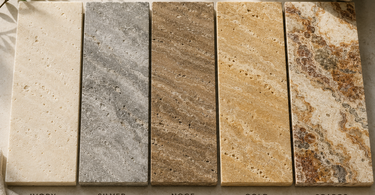
Ivory Travertine can feel light and understated. Silver Travertine introduces cooler gray movement. Noce creates rich brown depth. Gold brings stronger golden warmth. Scabos combines multiple earth tones in one highly expressive natural stone.
They are all travertine, but they do not create the same interior.
For someone buying natural stone tile, understanding these differences before choosing a color is important because travertine often covers a substantial visual area—floors, shower walls, bathrooms, kitchens, patios, entryways, or entire open-concept living spaces.
This guide compares Ivory vs Silver vs Noce vs Gold vs Scabos Travertine by color, variation, visual character, design style, format, and overall appearance to help you narrow down the right natural stone for your project.
Browse the complete Travertine Tile Collection to compare available travertine colors, sizes, and finishes.
Ivory vs Silver vs Noce vs Gold vs Scabos Travertine: Quick Comparison
If you're trying to decide quickly, start here.
| Travertine Type | General Color Family | Visual Character | Color Movement | Design Direction |
|---|---|---|---|---|
| Ivory Travertine | Cream, ivory, light beige | Soft and understated | Subtle to moderate | Organic modern, Mediterranean, coastal, transitional |
| Silver Travertine | Silver, gray, taupe | Directional and architectural | Moderate to strong | Contemporary, modern organic, dramatic luxury |
| Noce Travertine | Brown, walnut, earthy beige | Rich and grounded | Moderate | Traditional, Mediterranean, rustic luxury |
| Gold Travertine | Gold, honey, warm beige | Warm and expressive | Moderate to strong | Mediterranean, European, statement interiors |
| Scabos Travertine | Gold, rust, cream, brown | Multicolored and dramatic | Strong | Rustic luxury, Mediterranean, expressive natural-stone spaces |
Because travertine is natural stone, individual pieces and lots can vary. These descriptions represent the overall visual character of each color family rather than a promise that every tile will look identical.
That natural variation is part of what separates travertine from highly uniform manufactured surfaces.
1. Ivory Travertine: Light, Warm and Exceptionally Versatile
For buyers who want travertine without a strongly dramatic color palette, Ivory Travertine is often the natural place to begin.
Its overall appearance typically falls within a warm neutral range that can include:
-
ivory
-
cream
-
light beige
-
sand
-
subtle warmer movement
Ivory doesn't usually demand attention immediately. Instead, it creates a soft architectural foundation for the room.
That quality makes Ivory Travertine particularly effective when natural stone is being used across a large area.
What Does Ivory Travertine Look Like in a Finished Space?
Across an expansive floor, Ivory Travertine tends to create a lighter and more continuous visual field than darker travertine colors.
In a bathroom, the same stone can create a warm, refined environment without requiring heavy decoration.
In a great room, Ivory Travertine can become part of the architecture rather than a highly dominant design feature.
That makes it particularly well suited to buyers who want natural variation but don't want the floor to become the strongest visual element in the room.
For a clean large-format expression of this color family, explore the 18x18 Filled and Honed Ivory Travertine Tile.
What Styles Work with Ivory Travertine?
Ivory Travertine is unusually adaptable.
Modern Organic Homes: Larger formats can make Ivory feel clean and contemporary.
Mediterranean Interiors: Arches, textured walls, natural wood, and warmer architecture can emphasize Ivory Travertine's old-world character.
Coastal Luxury Homes: Its lighter palette can support bright interiors without creating the stark appearance of a pure white floor.
Transitional Homes: Ivory works particularly well when architecture combines traditional and contemporary elements.
Best for: buyers who want light, warm, flexible natural stone that can support many different interior styles.
2. Silver Travertine: The Contemporary Alternative
If Ivory is soft and warm, Silver Travertine is more architectural.
Its natural palette can include:
-
silver
-
gray
-
taupe
-
charcoal movement
-
occasional warmer undertones
One of the biggest misconceptions about Silver Travertine is that it behaves like a flat gray tile.
It doesn't.
Natural Silver Travertine can have significant directional movement and tonal layering, giving the stone a much more complex appearance.
For a pattern-focused example, compare the Silver Travertine Brushed and Chiseled Versailles Pattern Tile.
Does Silver Travertine Look Modern?
It certainly can.
Silver Travertine is particularly compelling when combined with:
-
larger tile formats
-
straight layouts
-
restrained architecture
-
large windows
-
minimal interiors
In that environment, the natural movement becomes an architectural feature.
This is very different from the warm Tuscan aesthetic people sometimes automatically associate with travertine.
Travertine does not have one design identity.
Color, finish, format, and layout completely change how the material reads.
Ivory vs Silver Travertine
Choose Ivory when you want the stone to feel lighter, warmer, softer, and more neutral.
Consider Silver when you want stronger movement, cooler coloration, greater visual contrast, and a more contemporary direction.
Neither is universally better. They create different visual results.
Best for: buyers who want natural travertine character with a cooler, more contemporary direction.
3. Noce Travertine: Rich Brown Natural Stone
Noce Travertine moves decisively away from the light-neutral character of Ivory.
The color family is generally associated with:
-
brown
-
walnut
-
coffee
-
warm earth tones
-
darker beige variation
That creates a much richer visual foundation.
A smaller-format example such as 6x6 Tumbled Noce Travertine Tile shows how the deeper color family can take on a warm, textural appearance.
What Kind of Interior Does Noce Travertine Create?
Noce is particularly effective when the goal is warmth and depth.
It can feel at home in:
-
Mediterranean architecture
-
rustic luxury homes
-
European-inspired interiors
-
traditional bathrooms
-
warm entryways
-
richly layered spaces
Where Ivory tends to visually lighten a room, Noce can visually ground it.
That difference becomes especially noticeable when natural stone covers a large floor or wall.
Does Noce Travertine Have to Look Traditional?
No.
The color itself is deeper than Ivory or Silver, but the finished aesthetic depends heavily on format and surrounding architecture.
Small pieces and aged textures can emphasize Noce's old-world character.
Cleaner formats and restrained interiors can give the same color family a more sophisticated expression.
Best for: buyers who want deeper brown natural stone and a warm, grounded interior.
4. Gold Travertine: Warm Stone with More Presence
Gold Travertine is for the buyer who does not want the natural stone to disappear quietly into the background.
Its palette may include:
-
warm beige
-
honey
-
gold
-
amber
-
cream
-
brown movement
Compared with Ivory, Gold generally has a stronger visual presence.
That makes it especially interesting where the natural stone itself is intended to contribute to the identity of the space.
A smaller-format example such as 4x4 Tumbled Gold Travertine Tile demonstrates how Gold can take on a distinctly warm, textural character.
Ivory vs Gold Travertine
These colors may both fall within the warmer travertine family, but visually they are quite different.
Ivory: more restrained, neutral, and lighter overall.
Gold: more expressive, warmer, and stronger in color.
If you want the architecture and furnishings to carry most of the visual drama, Ivory may provide the quieter foundation.
If you want the stone itself to contribute stronger warmth and character, Gold becomes much more interesting.
Best for: buyers who actively want warm golden natural stone rather than a quiet neutral surface.
5. Scabos Travertine: Maximum Natural Color Variation
Among these five travertine families, Scabos is generally the most visually expressive.
Rather than being defined primarily by one dominant neutral, Scabos can combine multiple earthy colors.
Its appearance may include:
-
cream
-
beige
-
gold
-
rust
-
brown
-
reddish earth tones
The result is unmistakably natural.
Explore a smaller-format expression through the Scabos Travertine Mosaic.
What Makes Scabos Different from Gold Travertine?
Gold is warm.
Scabos is multidimensional.
While Gold Travertine may center more strongly around golden and honey tones, Scabos can display a broader range of contrasting earth colors within the same overall installation.
That makes it especially suitable for buyers who consider natural variation a feature rather than something to minimize.
Where Does Scabos Look Best?
Scabos can be particularly striking in:
-
Mediterranean interiors
-
statement floors
-
feature areas
-
rustic luxury homes
-
mosaic applications
-
spaces centered around natural materials
It is not the travertine to choose if your goal is a highly uniform beige surface.
And that's precisely the point.
Best for: buyers who want unmistakable natural stone character and significant color movement.
Which Travertine Color Looks the Most Modern?
For a contemporary interior, Silver and Ivory Travertine are two of the strongest starting points.
But color alone doesn't determine whether travertine looks modern.
Consider:
Ivory + large format + honed finish + straight layout
versus:
Ivory + small format + tumbled finish + traditional pattern
Both use Ivory Travertine, yet the finished spaces can look completely different.
Likewise, Silver Travertine can become highly architectural when its directional movement is emphasized across larger surfaces.
When shopping for modern travertine, evaluate four characteristics together:
color + finish + size + layout
rather than choosing by color alone.
Which Travertine Color Has the Least Visual Movement?
Buyers looking for a calmer natural stone appearance will generally want to begin by exploring lighter Ivory and beige selections.
But this needs an important qualification: travertine is natural stone.
Variation can occur from:
-
piece to piece
-
crate to crate
-
quarry section to quarry section
-
lot to lot
There is no responsible way to promise that every piece of natural travertine will have identical movement.
If natural variation is something you love, that individuality is part of travertine's appeal.
If absolute uniformity is your highest priority, remember that natural stone is not intended to look identical from piece to piece.
Which Travertine Color Has the Most Variation?
Among the colors compared in this guide, Scabos generally provides the strongest multicolor appearance.
Gold can also display considerable warm variation.
Silver can show dramatic movement, but its character is different—often more directional and tonal rather than the broad earthy multicolor palette associated with Scabos.
There are different types of visual character:
-
Silver: directional movement
-
Gold: warm color movement
-
Scabos: multicolor natural variation
-
Noce: deep tonal richness
-
Ivory: softer natural movement
Which Travertine Color Makes a Room Feel Lighter?
If creating a lighter overall visual environment is the priority, Ivory Travertine is usually the strongest candidate among these five families.
Its cream and light beige palette can create an expansive appearance across large floors and walls.
This is one reason Ivory works beautifully in:
-
open-plan homes
-
bathrooms
-
bright kitchens
-
coastal interiors
-
large living spaces
For buyers specifically interested in light natural stone, Ivory deserves to be compared before moving into deeper Noce, Gold, or highly varied Scabos selections.
Which Travertine Is Best for a Luxury Bathroom?
There isn't one correct color. Instead, decide what kind of luxury you're trying to create.
Light, Understated Luxury
Consider Ivory Travertine.
Contemporary Architectural Luxury
Consider Silver Travertine.
Rich Traditional Luxury
Consider Noce Travertine.
Warm Mediterranean Luxury
Consider Gold Travertine.
Expressive Natural-Stone Luxury
Consider Scabos Travertine.
This is more useful than asking which travertine is simply "best."
The best choice is the stone whose visual character matches the space you actually want to create.
Which Travertine Works Best for Large Floors?
Large floors magnify whatever characteristics exist in the stone, making the color decision especially important.
Ivory creates a lighter, calmer field.
Silver creates more visible movement and architectural direction.
Noce creates deeper warmth and visual weight.
Gold creates a warm and expressive surface.
Scabos turns natural variation itself into a major design feature.
For open-concept homes and larger flooring projects, explore the complete Travertine Tile Collection.
Field Tile vs Travertine Mosaic: Why the Same Stone Can Look Different
A travertine color can look dramatically different depending on scale.
Large field tiles allow you to see more of the stone within each individual piece.
Mosaics break the same material into smaller visual units.
Mosaics can create:
-
more texture
-
more pattern
-
greater color concentration
-
stronger visual rhythm
while larger field tile can create:
-
broader stone movement
-
cleaner surfaces
-
more architectural continuity
If you're considering smaller-format stone, browse the Travertine Mosaic Tile Collection alongside field-tile selections rather than treating them as unrelated categories.
How to Choose Your Travertine Color
If you're still undecided, reduce the decision to the look you want.
Choose Ivory Travertine if:
You want light, warm, understated natural stone.
Choose Silver Travertine if:
You want cooler tones and stronger architectural movement.
Choose Noce Travertine if:
You want rich brown depth and warmth.
Choose Gold Travertine if:
You want golden color to become an important part of the design.
Choose Scabos Travertine if:
You want strong natural variation and multiple earth tones.
That is a better way to shop for travertine than simply asking which color is currently fashionable.
Natural stone is a long-term architectural material. Choose the stone whose character you want to live with.
Frequently Asked Questions
What is the lightest travertine color?
Among Ivory, Silver, Noce, Gold, and Scabos, Ivory generally provides the lightest overall visual direction, with cream and light beige tones. Because travertine is natural stone, individual pieces can vary.
Is Silver Travertine gray or beige?
Silver Travertine is generally associated with silver and gray coloration, but natural pieces may also contain taupe, beige, or warmer undertones. It should not be expected to look like a perfectly uniform gray manufactured tile.
What is the difference between Noce and Scabos Travertine?
Noce generally centers around deeper brown and walnut tones. Scabos typically contains a broader mixture of cream, gold, rust, brown, and other earthy colors, creating a more multicolored appearance.
What is the difference between Ivory and Gold Travertine?
Ivory is generally lighter and more neutral. Gold Travertine typically has stronger honey, gold, and warm earth coloration and therefore creates a more expressive surface.
Which travertine color looks most contemporary?
Ivory and Silver are particularly adaptable to contemporary interiors, especially in larger formats and clean layouts. Silver typically creates the more dramatic architectural appearance of the two.
Which travertine has the most natural color variation?
Scabos is known for pronounced multicolor variation. Gold can also show significant warm movement, while Silver may display strong directional variation.
Should every piece of travertine match?
No. Travertine is natural stone, and differences in tone, markings, movement, and texture should be expected. The overall surface should be viewed as a natural composition rather than expecting every tile to be identical.
Should I choose travertine based only on a website photograph?
Photographs are useful for understanding the general character of a stone, but natural travertine varies. Color, movement, and individual markings can differ, and that variation should be considered part of the material.
Final Comparison: There Is No Single "Best" Travertine Color
Ivory, Silver, Noce, Gold, and Scabos Travertine are not simply different shades of the same floor.
Each creates a different architectural mood.
Ivory is light and quietly luxurious.
Silver is directional and contemporary.
Noce is deep and grounded.
Gold is warm and expressive.
Scabos celebrates natural variation.
The right choice depends on whether you want the stone to create a subtle foundation or become one of the defining visual features of the space.
And that's ultimately what makes travertine such an interesting material to design with.
It doesn't offer one look.
It offers an entire natural color spectrum.
Explore the Mosaic Bros Travertine Tile Collection and Travertine Mosaic Tile Collection to compare available colors, sizes, finishes, and formats.
